Scenario Trainer
Work through realistic EMS calls, identify the high-value cues, and compare your reasoning against a guided breakdown.
Start a scenario
Train the judgment behind the answer with realistic EMS calls, cue-focused review, and timed exam practice built for EMT students.
Scenario, exam, and review practice.
Learn what details should change care.
Return to the domains that need reps.
Practice paths
Start with open reasoning, tighten pacing in exam mode, then reinforce the facts and patterns that keep showing up.
Work through realistic EMS calls, identify the high-value cues, and compare your reasoning against a guided breakdown.
Start a scenarioBuild test pacing with timed, one-question-at-a-time sets that mirror the pressure and distractors of exam day.
Run exam modeReinforce key assessments, pathophysiology, and treatment priorities with fast focused review sessions.
Review cardsClinical reasoning
PathoLogix is less about memorizing a single fact and more about practicing the chain of decisions that leads to better care.
Practice seeing vital signs, mechanism, red flags, and presentation details as a connected clinical picture.
Each scenario pushes you to choose, then explains the priority of care and why distractors are less appropriate.
Question flow, tone, and answer structure are tuned for exam preparation without losing field relevance.
Use performance history to spot weaker domains and decide what to practice next.
Scenario flow
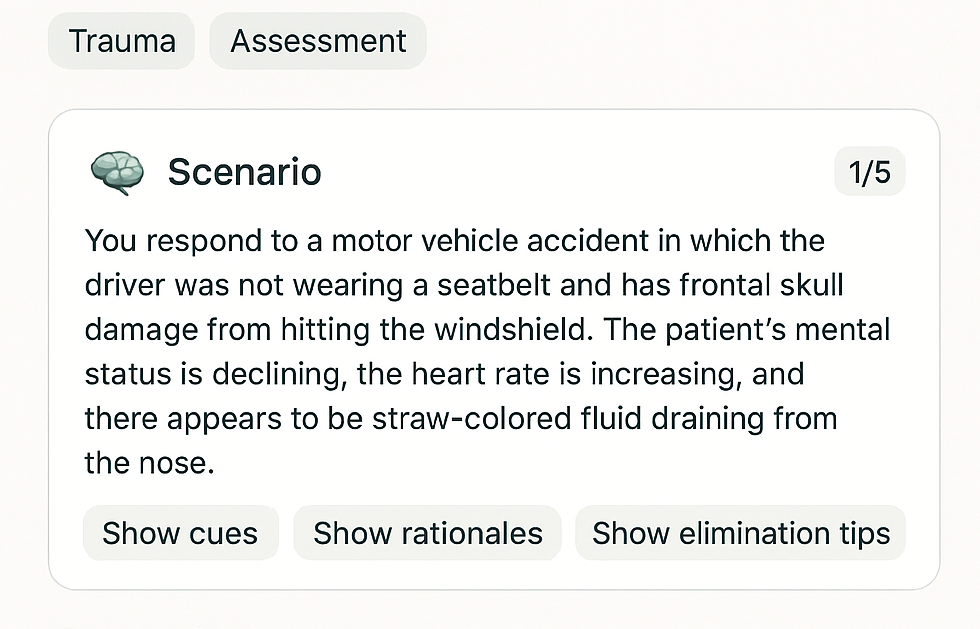
The trainer keeps the patient story, answer choice, and rationale close together so students can connect field details to care priorities.
Read the call and commit to the immediate priority.
Surface critical cues and compare them against distractors.
Review the step-by-step rationale behind the best answer.
Loop weak domains back into targeted practice.
Why it sticks
The best practice loop is simple: make a decision, see what mattered, then do another focused rep before the pattern fades.
High-yield cues are called out after the decision.
Rationales explain why the best answer beats close distractors.
Timed mode keeps pacing honest under pressure.
Progress review helps choose the next study target.
Learning Center
Source-backed EMT study guides connect assessment sequences and clinical findings to the choices you make in a scenario.
Learn a repeatable EMT primary assessment sequence for identifying immediate life threats and deciding transport priority.
Read guideReview the EMT scene size-up process, including safety, PPE, mechanism or nature of illness, patient count, and additional resources.
Read guideStudy the respiratory, cardiovascular, skin, gastrointestinal, and neurologic findings that can indicate anaphylaxis.
Read guideReady for the next rep?
FAQ
Yes. The scenarios, distractors, and rationales are shaped around NREMT-style decision making while staying focused on real EMT reasoning.
Yes. You can move between scenario practice, timed exam sets, flashcards, and progress review depending on what needs the most reps.
Learning practice makes the reasoning visible. Exam mode adds time pressure and hides feedback until you submit so you can build test discipline.